
Congress leaders on Monday termed the reorganisation of the Madhya Pradesh Waqf Board with the inclusion of two Hindu members as "inappropriate" and said they would challenge the decision in the Supreme Court.

The new TTD chief said all those who work at Tirumala should be Hindus.
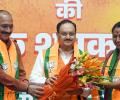
BJP president JP Nadda said on Sunday that the party does not seek to control the Waqf Board but wants to ensure that those managing it operate within the bounds of law and adhere to established rules. He said the properties and funds of the Waqf Board should be dedicated to promoting education, providing healthcare and employment opportunities for the Muslim community. Nadda also highlighted the BJP's growth and achievements, emphasizing its commitment to national unity and cultural heritage.
Would have constructed Ram temple on 5 acre land if given to us: UP Shia Central Waqf Board

The monsoon session of Parliament will set the tone for how the Hindu community feels about what happened at the Ram Mandir. Whether emotions will be stirred within the voters of India lies solely at the oratory skills of the Congressis and Samajwadis, notes Zainab Sikander.
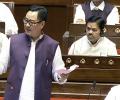
'It is not as if Hindus are not being touched at all, and only Muslims are.'

The Shia Waqf Board is drafting the terms and conditions of a mutual agreement.

They stated that when a soldier fights for the nation, he does so not as a Hindu, Muslim, or any other religion, but as a patriot.

The Supreme Court expressed its disapproval of an analogy used by the Centre in support of the inclusion of non-Muslims in Waqf boards, stating that such logic would disqualify a bench of Hindu judges from hearing matters related to Waqf. The CJI questioned the Centre's stance on the provisions of the Waqf (Amendment) Act, 2025, which allows non-Muslim members in the Central Waqf Council and state waqf boards. The Solicitor General defended the provisions, emphasizing that the non-Muslim inclusion is limited and does not impact the Muslim composition of these bodies. However, the CJI asserted that judges shed their religious affiliations while serving on the bench and maintained their secularity in their judicial capacity.
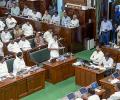
The Tamil Nadu Assembly passed a resolution on Thursday condemning the Centre's proposed Waqf Amendment Bill 2024, calling for its recall. Chief Minister M K Stalin argued that the amendment interferes with religious affairs and would negatively impact the Muslim minority. The resolution was unanimously passed by the Assembly, with support from all parties, including the opposition AIADMK and PMK. The BJP, however, walked out in protest, accusing the ruling DMK of engaging in divisive politics. The bill aims to streamline the Waqf Board's work and ensure efficient management of Waqf properties but has been criticized for potentially encroaching on religious freedom and autonomy. The Tamil Nadu government claims that the amendment would lead to government control over the Waqf Board and its properties, impacting its autonomy and potentially allowing for government acquisition of Muslim-owned lands.

The Supreme Court of India began hearing a batch of petitions challenging the constitutional validity of the Waqf (Amendment) Act, 2025. The bench, led by Chief Justice Sanjiv Khanna, asked both sides to address whether the court should entertain the petitions or relegate them to the high court. The hearing is underway with senior advocate Kapil Sibal arguing for the petitioners. The act, which was passed by Parliament following heated debates, has been challenged by various parties including AIMIM leader Asaduddin Owaisi, All India Muslim Personal Law Board (AIMPLB), and Jamiat Ulama-i-Hind.

Over one lakh Muslims gathered in Karnataka to protest the Waqf Amendment Act, 2025, which they say erodes the autonomy of Waqf institutions and threatens their rights. The protest, organized by the Karnataka State Ulema Coordination Committee, saw strong opposition to provisions in the amended law that they argue allow for coercive acquisition of Waqf properties. Leaders alleged that the amendment is part of a broader political agenda and urged the community to uphold their legal and constitutional rights.
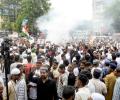
Congress MP Mohammad Jawed and AIMIM president Asaduddin Owaisi have challenged the validity of the Waqf (Amendment) Bill, 2025 in the Supreme Court, arguing that it violates constitutional provisions. The petitions claim the bill imposes arbitrary restrictions on Waqf properties and their management, undermining the religious autonomy of the Muslim community. They also allege that the bill discriminates against Muslims by imposing restrictions not present in the governance of other religious endowments. The bill was passed in the Rajya Sabha and Lok Sabha, with the petitioners arguing that it introduces limitations on the creation of Waqfs based on the duration of one's religious practice, mandates inclusion of non-Muslim members in Waqf administrative bodies, and shifts key administrative functions to government officials, thereby diluting the autonomy of Waqf management.
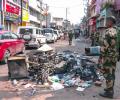
'There's no transparency in work (of the Wakf Board), in property transactions (of the Waqf).'

The Tirumala Tirupati Devasthanams (TTD), the custodian of Lord Venkateswara Swamy temple, has barred 18 employees from participating in all religious activities for allegedly partaking in non-Hindu activities. The decision has been defended by the Andhra Pradesh government, citing the need to protect the religious sentiments of Hindu devotees. The move has sparked debate, with some supporting the TTD's stance and others criticizing it as discriminatory.

The Madhya Pradesh High Court referenced the Supreme Court's Ayodhya verdict principles while ruling on the Bhojshala-Kamal Maula mosque complex case, determining the site to be a temple dedicated to Goddess Saraswati.
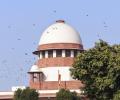
The Indian government defended the Waqf (Amendment) Act, 2025 in the Supreme Court, arguing that waqf, while an Islamic concept, is not an essential part of Islam. Solicitor General Tushar Mehta stated that waqf is essentially charity, which is recognized across religions, and cannot be considered a fundamental tenet of any faith. He also argued that the amended law addresses secular aspects of waqf and activities unrelated to Islam, and that "waqf by user" does not grant ownership of public land. Mehta highlighted the extensive consultations involved in the bill's creation, including feedback from various stakeholders. The hearing will continue on Thursday.
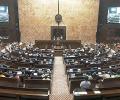
The Waqf (Amendment) Bill, 2025 was passed in the Lok Sabha early Thursday, with 288 members supporting it and 232 against it.
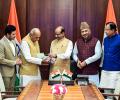
'When voting clause by clause on Waqf came up in the JPC, the TDP and JD-U supported the BJP on each and every clause.'

The Supreme Court of India has reserved its interim orders on three key issues related to the Waqf (Amendment) Act, 2025, including the power to denotify waqf properties, the composition of waqf boards, and the provision regarding government land. The court heard arguments from both the petitioners, who challenged the validity of the amended law, and the Centre, which defended the Act as a secular concept. The petitioners sought interim orders to prevent the implementation of certain provisions while the court considers the legal challenges.

Two individuals claiming to be members of the Janata Dal (United) (JD(U)) in Bihar announced their "resignation" from the party, citing dissatisfaction with its support for the Waqf (Amendment) Bill. The JD(U) denied the resignations, claiming the individuals were not party members. However, some senior JD(U) leaders have expressed discontent over the passage of the bill, which they believe is detrimental to Muslims. The controversy over the Waqf Bill is likely to influence the upcoming assembly elections in Bihar.

The meeting of the Joint Committee on Waqf (Amendment) Bill took an ugly turn as the Trinamool Congress MP smashed a glass water bottle and threw it towards panel chairman Jagdambika Pal of the Bharatiya Janata Party during a heated exchange of words with BJP's Abhijit Gangopadhyay, a former Calcutta high court judge.

'A genuine tribute to Dr Ambedkar does not lie in selective invocation. It lies in asking a harder question: Is the Constitution still doing its job -- restraining even assertive majorities?' asks Manoj Mohanka.
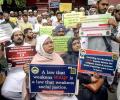
'The new Waqf bill sows the seed for conflict in every town and village of India.'
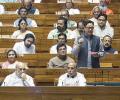
'Muslims need to work according to strategy and not fall into the trap of Opposition parties.'

Delhi Waqf Board chairman Amanatullah Khan in a letter to ASI director general, last week, requested for allowing namaz at the "ancient" Quwwat-ul-Islam mosque in Qutab Minor complex.
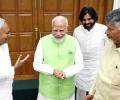
It also cautioned that if the legislation is passed, the "two crutches" on which the Bharatiya Janata Party-led government is running at the Centre would not be able to escape responsibility.
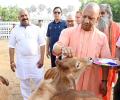
Uttar Pradesh Chief Minister Yogi Adityanath, known for his hardline Hindutva views and 'bulldozer justice' approach, has spoken out about his policies toward Muslims, the Waqf board, and his vision for India. He asserts that Muslims will receive a fair share of development in Uttar Pradesh, but not special concessions. He also criticizes the Waqf board for its alleged appropriation of government properties and calls for its reform. Adityanath defends his 'bulldozer justice' policy, claiming it is necessary for infrastructure development and removal of encroachments. He also discusses his vision for India, emphasizing the importance of Hindi as a national language and the need for unity across different linguistic groups.

AIMPLB member Zafaryab Jilani on Wednesday said the proposed mosque in Ayodhya following last year's Supreme Court verdict is against the Waqf Act and 'illegal' under the Shariat laws.
The lawyers said the mediation panel's report was leaked to the media and they do not approve the procedures adopted in the process and the suggested compromise formula of withdrawal of the lawsuit.

Hindu outfits that took out a march in Kullu demanding the demolition of the mosque were involved in a scuffle with the police on Monday.

Modi can abandon the path of Hindutva only at risk to his position within his own fraternity. But if he pursues a hard line, he faces the risk of being hauled up by his coalition-partners. For the first time in a decade, Modi is not in enviable situation, observes Nilanjan Mukhopadhyay.

The Supreme Court on Wednesday refused to entertain a plea seeking to prevent a 'mahapanchayat' called by Hindu outfits in Uttarakhand and registration of an FIR against hate speeches allegedly targeting members of a particular community.

The BJP may be in the Opposition in many states, but nowhere is it as divided as it is in Karnataka, points out Aditi Phadnis.

'The locals want a permanent solution to the perennial Mandir-Masjid issue. They have realised political parties will lose relevance if a temple is built.'

While Ayodhya resembled a city under seige earlier during the day, the scene was no different elsewhere in the state with police and central forces keeping an eye over the security situation and Chief Minister Yogi Adityanath personally monitoring it from a hi-tech control room in the state capital.

From the kind of food to the art which will be displayed at the museum, historian Pushpesh Pant shares his vision.

Justice Agarwal retired from the high court on April 23, 2020.

Amid escalating tensions over the Sinjauli mosque in Shimla, a Muslim welfare committee on Thursday urged the municipal commissioner to seal the unauthorised portion and also offered to demolish it in accordance with a court order.

The Centre on Monday told the Delhi high court that Mughal Mosque in South Delhi's Mehrauli area is a "protected monument" and sought time to state its stand on a plea against the stopping of offering namaaz by devotees there.
